5 IEC Registration Challenges New Exporters Often Face
Starting an export business in India presents exciting opportunities, but it also comes with several regulatory requirements that must be completed before shipping products overseas. One of the first and most important steps is obtaining IEC Registration. Issued by the Directorate General of Foreign Trade (DGFT), the Import Export Code serves as the primary identification number for businesses involved in importing or exporting goods and services.
Although the application process is now fully digital, many first-time exporters encounter avoidable challenges that delay approvals or create compliance issues. Understanding these obstacles can help businesses prepare better and complete IEC Code Registration without unnecessary complications.
At Exim Advisory, businesses receive professional guidance throughout the Import Export Code Registration process, ensuring accuracy, compliance, and timely approvals.
Why IEC Registration Is Essential
Before exploring the common challenges, it is important to understand why IEC Registration is necessary.
An Import Export Code is mandatory for most businesses that wish to import goods into India or export products to international markets. Without this registration, businesses may face difficulties in customs clearance, international banking transactions, and export documentation.
Apart from fulfilling legal requirements, IEC Code Registration establishes credibility with overseas buyers, logistics providers, customs authorities, and financial institutions.
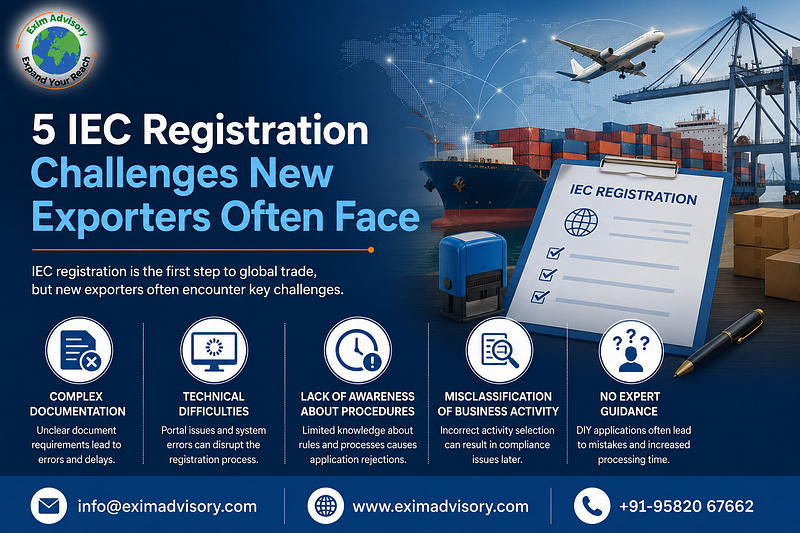
Challenge 1: Incomplete or Incorrect Documentation
One of the biggest reasons for delays during Import Export Code Registration is submitting incomplete or inaccurate documents.
Many first-time exporters overlook document consistency. Differences between PAN details, Aadhaar information, business addresses, or bank account records often result in application queries or rejection.
Common documents generally required include:
- PAN of the applicant or business
- Aadhaar details
- Business address proof
- Bank account proof
- Mobile number and email linked for verification
Even a minor mismatch can delay IEC Registration, making careful document verification essential.
Working with an experienced IEC Code Consultant helps businesses review documents before submission and avoid common filing mistakes.
Challenge 2: Choosing Incorrect Business Information
During IEC Code Registration, applicants must accurately provide business information, including legal constitution, business activities, and operational details.
Many new exporters mistakenly select incorrect categories or enter inconsistent information that does not match official records.
These mistakes can create future compliance issues and require amendments after approval.
Professional guidance ensures that every section of the application accurately reflects the business profile.
Challenge 3: Understanding DGFT Compliance Requirements
Although obtaining IEC Registration is relatively straightforward, exporters must also understand their ongoing responsibilities under DGFT regulations.
Many businesses incorrectly assume that obtaining the code completes all compliance obligations.
In reality, exporters must remain aware of:
- Profile update requirements
- Changes in business information
- Export policy notifications
- Regulatory amendments
- Annual compliance where applicable
An experienced IEC Code Consultant helps businesses remain compliant even after registration has been completed.
Challenge 4: Technical Errors During Online Filing
Since Import Export Code Registration is completed through the DGFT online portal, applicants occasionally experience technical issues.
These may include:
- Incorrect digital document uploads
- OTP verification failures
- Incomplete online forms
- Session timeouts
- Errors in digital signatures
Applicants unfamiliar with the online process often spend considerable time resolving technical issues.
Professional support reduces these delays by ensuring applications are prepared correctly before submission.
Challenge 5: Lack of Professional Guidance
Many new exporters attempt IEC Registration independently to reduce initial costs. While the online application appears simple, lack of professional guidance often results in repeated corrections, delayed approvals, or missed compliance requirements.
An experienced IEC Code Consultant not only assists with filing but also helps businesses understand export readiness, documentation standards, and future regulatory obligations.
For businesses planning long-term international growth, professional advisory support often proves more valuable than correcting mistakes later.
Best Practices for Successful IEC Code Registration
Businesses can significantly improve the success of their IEC Code Registration by following a structured approach.
Recommended practices include:
Verify Documents Before Filing
Ensure that all identity, address, and banking records are accurate and consistent.
Maintain Updated Business Records
Keep company information current across all government registrations.
Understand Export Compliance
Learn the regulatory responsibilities associated with international trade before beginning export operations.
Seek Professional Advice
Working with an experienced IEC Code Consultant reduces filing errors and helps businesses complete Import Export Code Registration more efficiently.
Plan for Future Growth
Treat IEC Registration as the first step toward building a compliant export business rather than merely obtaining a certificate.
Why Professional Support Makes a Difference
Although the application process has become digital, export compliance continues to evolve.
Professional assistance offers several advantages:
- Faster application preparation
- Accurate documentation review
- Reduced rejection risk
- Guidance on DGFT procedures
- Ongoing regulatory support
- Assistance with amendments and updates
A knowledgeable IEC Code Consultant helps businesses complete IEC Code Registration confidently while avoiding unnecessary delays.
Why Choose Exim Advisory
Exim Advisory provides comprehensive support for businesses seeking IEC Registration across India.
Their services include:
- Eligibility assessment
- Complete Import Export Code Registration assistance
- Documentation review
- DGFT portal filing support
- Compliance advisory
- Registration amendments and updates
With years of experience in trade compliance, Exim Advisory helps exporters complete IEC Code Registration accurately and efficiently while preparing them for long-term international business operations.
Conclusion
Every successful export business begins with proper compliance, and IEC Registration is one of the most important milestones in that journey. While the registration process is relatively simple, new exporters often face challenges related to documentation, technical filing, regulatory understanding, and procedural accuracy.
By recognizing these common issues early and seeking professional guidance, businesses can avoid unnecessary delays and focus on expanding into global markets.
Partnering with Exim Advisory and an experienced IEC Code Consultant ensures that Import Export Code Registration is completed smoothly, allowing businesses to begin their export journey with confidence and full regulatory compliance.


Comments
Post a Comment